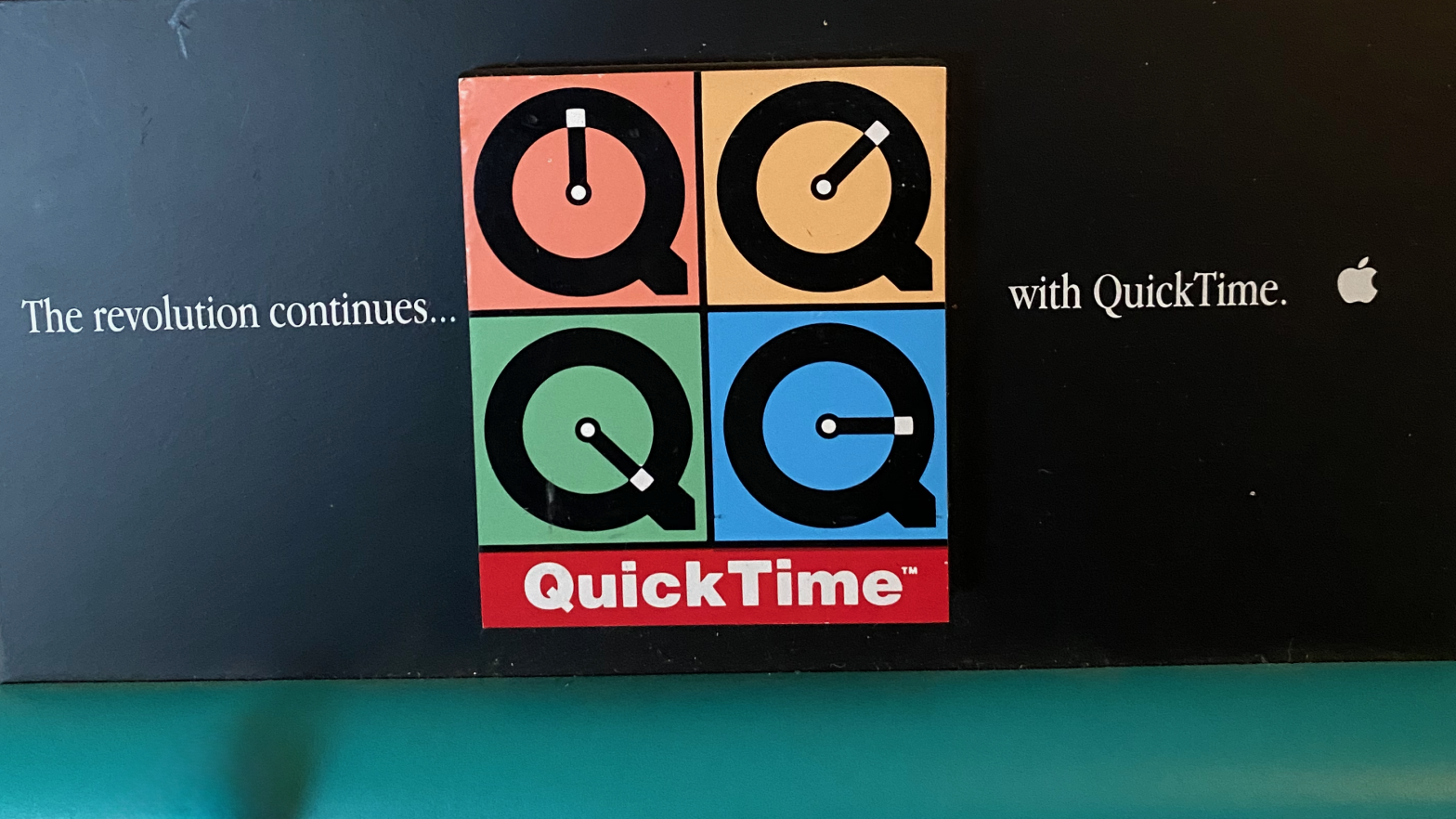
It was 1991 and we at The Voyager Company had been working on a CD-ROM titled “Baseball’s Greatest Hits” in HyperCard when our Apple evangelist contacted us about testing something called “QuickTime.” I cannot recall if there was a code name, but I do recall the first compressor (CODEC) was named “road pizza”, as it was a fairy simple brute force compression algorithm.
We of course became super excited and Bob or whomever started working on the digital rights to the footage that Suzy and others had dug up.
The QuickTime 1.0 file format was incredible. It consisted of “tracks” that could represent video, audio, text, images or even aliases to audio stored outside of the movie file. We decided that we did not want to limit the market for BGH to just those with color Macs that had enough processing power to play video, so we decided to take advantage of the audio alias feature.
I wrote an XCMD for HyperCard that would double buffer the audio streaming out of the AIFF file on the CD-ROM and allow for various audio playback functionality.
We then also created QuickTime movies with audio alias tracks, so if the customer could use QuickTime then the software would use the QuickTime movie controller, the same as with video movies. I was (and still am) a big fan of simple, consistent user interfaces and I wanted to put the extra work in for our QuickTime customers.
The audio movies along with the video movies worked flawlessly. We were working late through December, 1991 to get ready to ship at MacWorld in early January, 1992, the first public appearance of QuickTime.
MacWorld usually started on a Thursday and on the Thursday the week before, we received what I recall to be the QuickTime 1.0 master from Apple. We installed it and while the video worked, all hundreds of the audio movies did not. We AppleLinked the QuickTime team who, unfortunately, had to make a last minute change to the file format.
Because time was short, Apple asked me to fly up from Santa Monica to Cupertino so we could quickly fix the files, vs. trying to make a custom app and send versions over dial up. Kids these days don’t know how good they have it, do they?
I arrived at LAX for a 7am flight with a large, heavy breadbox sized 1 gigabyte hard drive with all of our data. I had asked around and the consensus was that the X-Ray machine would not harm the data on the drive.
As the massive brick of video, audio and software rode the belt through the machine, I set off the metal detector. I stepped through and the security wand beeped on my right side jacket pocket. At the same time, the hard drive emerged from the scanner.
Security asked me to remove the item in my pocket, so I did and showed it to them. They asked what it was and me being a dumb, not yet awake idiot, pointed to the hard drive and said, with all seriousness, “This is the terminator to that box over there.”
It only took a few seconds for security to move me up against the wall. This was 1992, fortunately. Such a dumb move would probably have more dire consequences these days. They asked me to explain and I told them that the hard drive uses a “scuzzy” bus to connect to the computer and it needs this thing plugged in at the end of the chain of devices.
They wanted me to prove that the hard drive was not a bomb, so I asked “How would you like me to do that? It already went through X-Ray.”
They told me, and again, in all seriousness, to plug the hard drive in, turn it on and show them the power light. Dumbfounded, I followed directions, the tiny red LED lit up and started blinking and they were satisfied.
I learned a hard lesson about security theater at a young age.
I arrived at Apple and the awesome QuickTime team (Peter, Bruce, George, Sean, John and more) helped me recreate every movie fairly quickly. By evening, I was on a flight back to L.A.
We sent the new master DAT tape off to Sony, they pressed our CD-ROMs over the next few days, and we delivered some of the first commercially available video on a computer.
I consider myself the luckiest man on the face of the Earth – Lou Gehrig.